Codenames: Choosing the Best Word
The table-top game Codenames pits two teams of spies against each other in a manner that exercises each person's ability to carefully choose words and to recognize associations with chosen words.

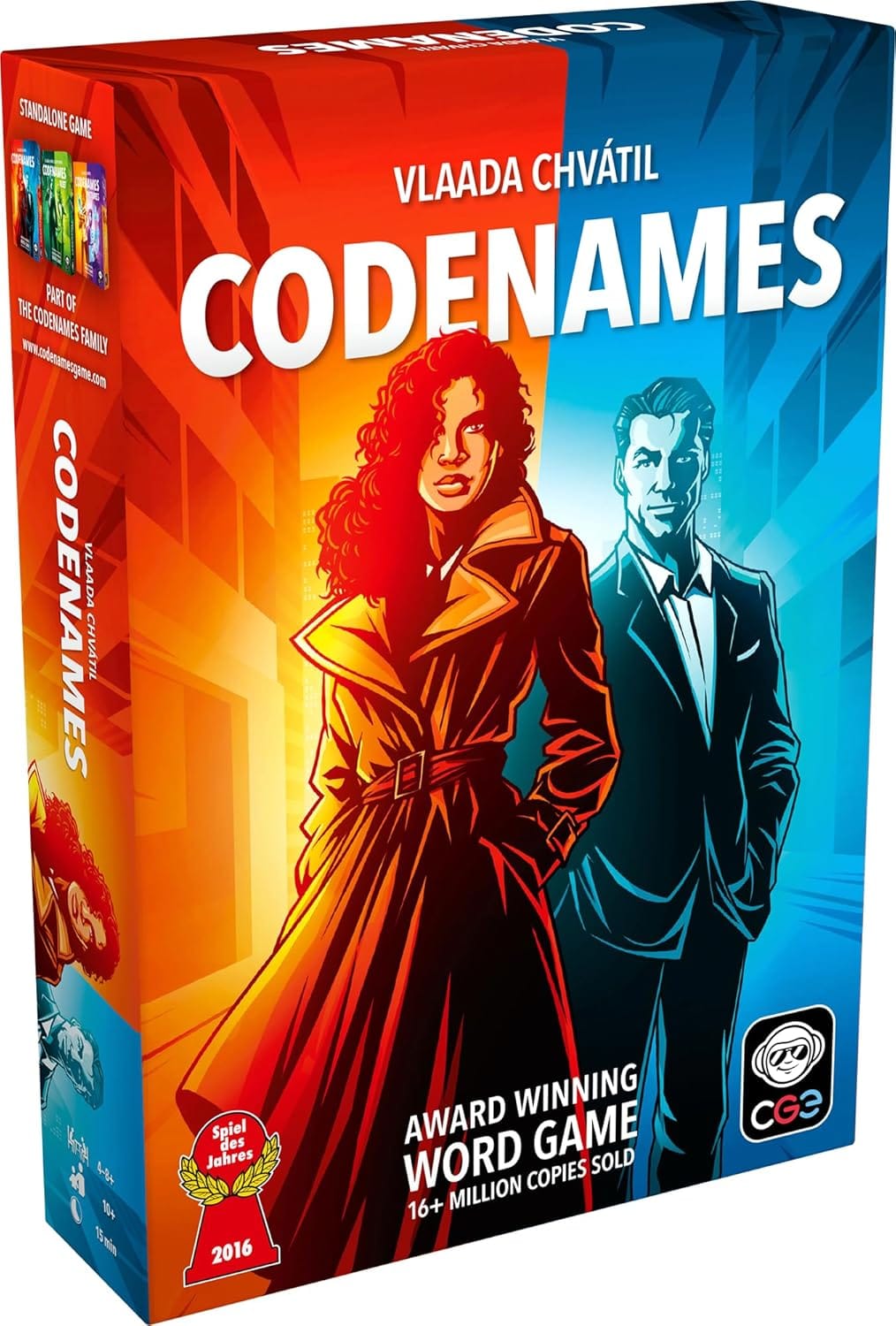
And here is another social game that is lots of fun and helps us sharpen our word choice skills! Our previous review on Just One! also emphasized the word choice aspects.
Designer: Vlaada Chvátil
Publisher: Czech Games Edition (CGE)
Style: Table-top party game
Players: 4-8 in two teams
Playtime: 10-30 minutes
Language: English in the US, some languages in Europe
Play skills: low rules, low luck, deduction, word association, language skills
No player character harms another player's character. Accidentally confronting an assassin (not a player), can mean a loss. (In the expensive Disney Family Edition the assassin is replaced by the game-over card.) This game is an opportunity to watch your children in cooperation.
One player per team acts as the spymaster, who gives one-word clues to help their teammates identify their team’s secret agents on a 5×5 grid of codenames. The other players are field operatives who guess the identities based on the clue. Teams compete to identify all of their agents first while avoiding the opposing team’s agents and the assassin—touching the assassin results in an immediate loss.
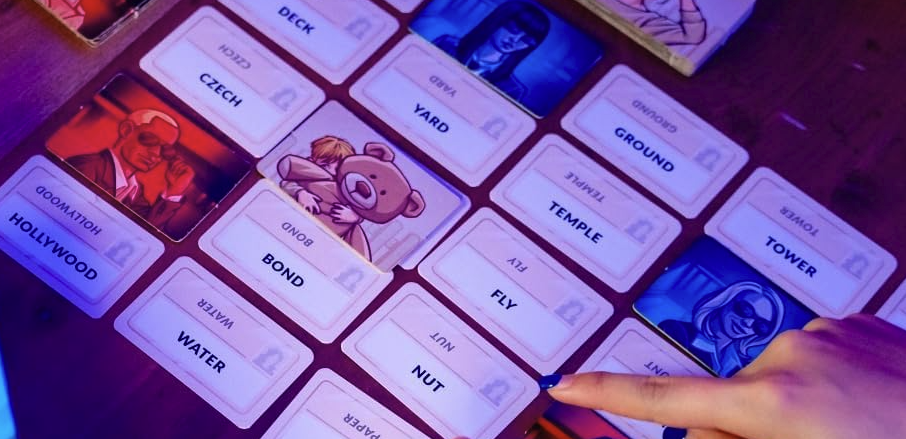
The spymaster provides a count with the association. A count might be a number or as special word. Allowed guess tries can depend on the count. I recommend considering simplifying this for some collections of people.
Knowledge
Knowledge can be important in making associations. This doesn't strike me as burdensome, but those from another culture might find teamwork important. To me this makes it more fun. The Disney version is highly focused in knowledge (Disney films for children), which might be good or bad. (Looks boring to me, but take that with a grain of salt.)

Reading
Reading is a required skill, however there is a picture version where reading is not required (except for reading the rules, but who needs rules). The picture version does require some interpretation of illustrations. For some gatherings, this is great. I have not examined the Disney version closely and I have not watched it played, but I think it does not require reading. And there is nothing wrong with operatives (guessers) reading words aloud for fellow operatives. There has been some exploration in using Codenames in game-based language (GBL) learning.

Variations
I love seeing multiple rounds where teams have a different spymaster each role.
There is a two person edition that looks fun, but I have not seen it in play. Sounds sweet.
It is easy to tweak the rules for the crowd. You can even get both the picture version and the printed word version.
Word Association
Word association connections live in our mental lexicon, the internal networks of words and meaning that language communicating persons have. A 2025 study in Cognition found that free word association is heavily driven by "local response chaining," where each response is more influenced by the previous response than by the original cue. In other words, our associations cascade — one thought triggers the next in a chain. The rules in Codenames opens this up.
Cognitive Skills
Codenames is a cognitive skill game. It is even used as a cognitive benchmark in studying LLMs.

Inductive Reasoning
The spymaster engages in inductive reasoning, moving from specific words, to a general discrimination concept that can be labeled by a single word. An analysis by Meeple Like Us says the more obscure and precise the clue, the more powerful it is. However, this demands more in linguistic fluency, nuance and shared cultural knowledge. The spymaster has to look at the rest of the team in selecting a word. Computational linguists have found Codenames interesting because it provides insight into common-sense understanding of the relationship between words; leading to geometric models for some. Inside jokes are OK.
Deductive Reasoning
The rest of the team uses deductive reasoning, working from the general to the specific. For more than two players on a team, this involves discussion. This is a nuanced deductive reasoning, almost probabilistic. Is the spymaster remembering this other sense of that word? Guessing behavior often tracks colocation association (words that often go together in text such as world/peace, brain/storm, lock/key, catch/cold and Romeo/Juliet). However, there might be actor-object, broad-narrow and other associations.
Mouth Fruit recommends this game.


Codenames Duet
This is the two-player cooperative version with compatible word cards. This looks like a nice game for couples.
View on Amazon
Codenames Pictures
This version removes the literacy requirement and allows focus on the spoken words.
View on Amazon