Mika Letters
The fifteen letters of the crafted language Mika are introduced.


The crafted language Mika is written with only fifteen letters: five vowels, five stops and five more. This can also be seen as ten voiced and 5 not.
Letters and sounds in Mika are closely bound; pairs become one. In most languages graphemes and phonemes have complicated relationships. They are simple in Mika. In this post, the sounds are not considered, just the glyphs.
The Letters of Mika
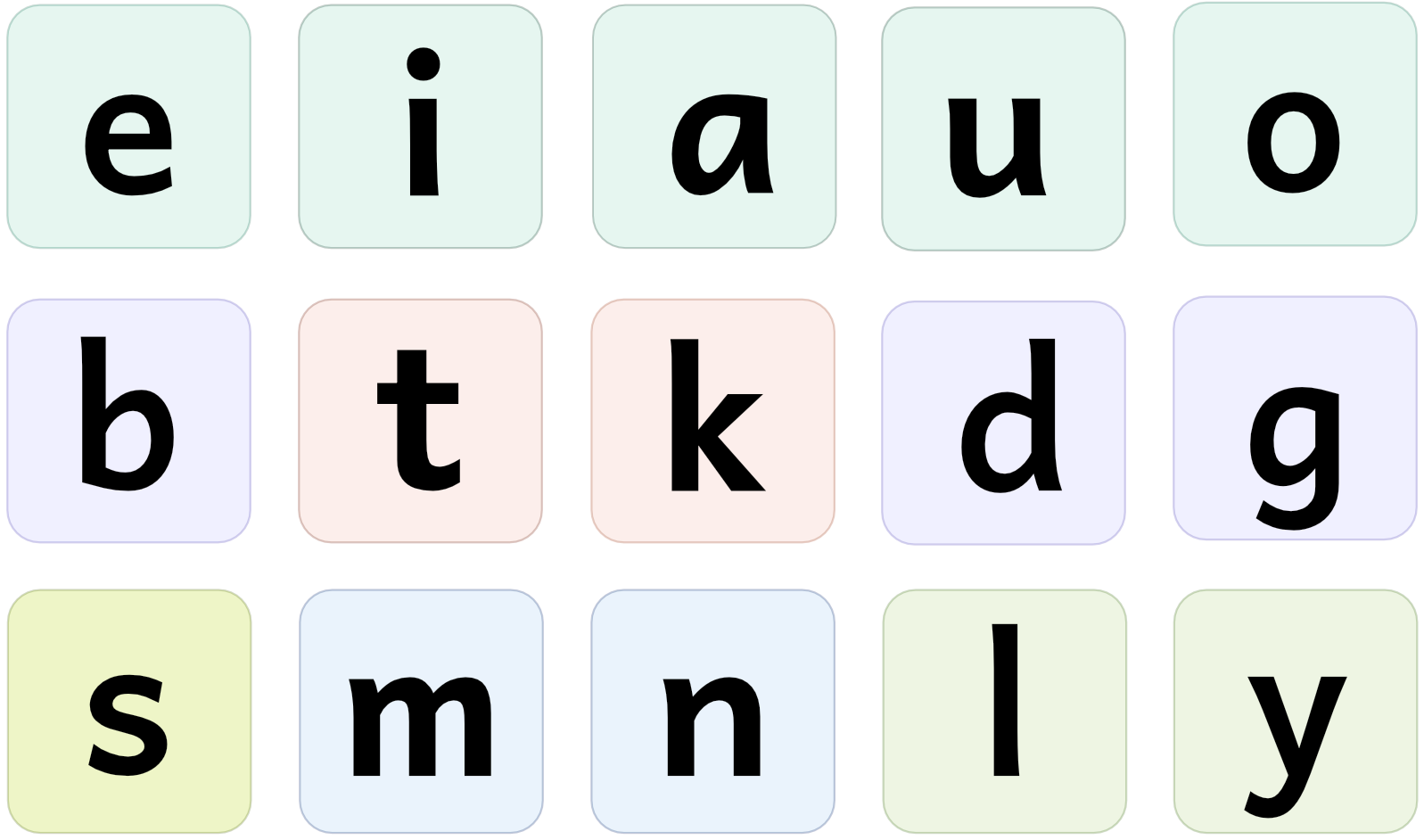
These symbols should look familiar, even boring. However, that means you and others around the world can learn them quickly. Those above are shown in the SIL Andika font.
Making Letters
One can learn one or more ways to express these letters. You can create the letters by doing these:
- Handwriting
- Typing on virtually all computer keyboard layouts
- Typing on most computer keyboards without using modifiers or modes
- Keying Morse code
- Tapping tap code (no ambiguity in Mika)
- Waving flag semaphores (no Mika letters compete with 'letters following')
- Signing ASL letters (only static hand-signs are needed for Mika spelling)
- Embossing Braille
- Using anything that can create ASCII letters
You can also recognize them produced that way.
Typing Fast
Here are a couple ways that Mika words can be typed quickly and perhaps in the speech rhythm. These are syllable typing and chorded typing.
Syllable Typing
Some syllables in Mika can be typed quickly by tapping two keys at the same time with the consonant going down slightly before the vowel. It feels like learning a few chords on a chorded keyboard and can be learned as needed. There are 55 possible syllables in Mika (double in special cases) and the most common can be typed as one.
Try the two-handed ya. Tap both y and a but the y is faster. This syllable sounds like the German word for yes.
Now try a syllable involving letters on the same hand: sa, ko or on. Or adding space after the syllable.
This will not work on an old typewriter or if you are a single finger typist. A two finger typist might be able to do many.
This is limited version of the key rollover method which can be used in even more ways to type Mika.
Chorded Typing
Some special keyboards can extend key rollover by allowing the tapping several keys at once or using rolling keys. If such a keyboard can handle the Mika letters, then those can be typed fast.
However, the promise might be in one-handed keyboards or gloves. The reduced number of letters might allow a useful and fast typing that allows the other hand to use a mouse, laser pointer or paint brush.
Tech Stuff
Binary Encoding
The 7-bit ASCII or the 8-bit UTF8 readily cover these letters as do historical 5-bit codes. The 15 letters plus an escape character or a space can be encoded in 4 bits (7 bits with error correction). Adding Huffman (Zapf) encoding where frequent letters are encoded with less bit and the rarely used letter use more bits can reduce the average number of bits per letter.
Mika is competitive in information per letter plus space.
Alphabetical Ordering
Sorting of unique words represented by a string of (lower-case) is deterministic. The word spelled with the leading letters of another comes before. The sorting of a string of words uses the sort order of the words.
Capitalization and punctuation can be considered decorative aids. Sorting with those is non-deterministic. The word 'akamimi' can be sorted before or after the stylistic 'Akamimi'. However, a deterministic rule is OK. In dictionaries this is not a problem.
Sorting is by the order of the corresponding English letters:
a b d e g i k l m n o s t u y
Thus, sorting by ASCII encoding ( or, equivalently, Unicode codepoint) works out fine.
Computer Programming with just Mika Letters
Many folks use programming languages and if restricted to the Mika letters in typing will find a problem in typing the reserved/key words; a full keyboard is needed. This limitation especially comes from the recent dropping of f and w impacting if, while and false. Finding programming languages or specification languages that do not require letters in keywords might be interesting. Some might require some UNICODE characters.
However, documentation can be done in Markdown (common) where the Mika letters are just fine.
TL;DR
Mika uses only these 15 letters on your keyboard:
e t y u i o
a s d g k l
b n
They are sorted like this:
a b d e g i k l m n o s t u y
The letters can be grouped into 3x5 grids including one with 5 vowels (e i a u o), five stops (b t k d g) and 5 other consonants (s m n l y). Or organized as in the table above.