The Joy of Humility


There's a certain kind of person you relax around. You might not immediately know why. They're not performing. They're not waiting for their turn to talk. When you say something, they actually consider it. If you disagree with them, you don't brace for impact.
That quality you're sensing? It's probably humility. Hmm. Too strong? How about this: Humility can be a major contributor to what you are sensing.
Not the shuffling, self-deprecating kind. Not "Oh, I'm nobody special." That's just insecurity in a humble costume. Real humility is something else entirely—something surprisingly attractive.
What Humility Isn't
Let's clear away some underbrush.
Humility is not thinking poorly of yourself. It's not minimizing your gifts or pretending you don't have them. A world-class pianist who says "I'm really not very good" isn't being humble, but is rather fishing for compliments or genuinely confused.
Humility is not letting people walk over you. The humble person can hold a position, argue a point, even stand strong for something important.
Humility is not weakness. It requires a kind of strength that is still developing as we progress.

So What Is It?
Let's step away from the negative. Let's look at the positive. We see what Mouth Fruit thinks is not humility? So...
What is humility?
Let's look at various voices on humility.
Christian View
— Rick Warren in The Purpose-Driven Life
Read that again. It's not about shrinking. It's about where your attention goes. The humble person is present, available and interested in what is happening.
If anyone would like to acquire humility, I can, I think, tell him the first step. The first step is to realise that one is proud. And a biggish step, too. At least, nothing whatever can be done before it. If you think you are not conceited, it means you are very conceited indeed.
— C.S. Lewis in Mere Christianity
In the Christian tradition, humility isn't self-hatred—it's accurate self-perception. You are a creature, finite yet infinite, prone to error, dependent on grace. But also: made in the image of God, beloved, capable of goodness. Humility holds both. It doesn't require you to grovel. It asks you to see clearly.
Paul wrote to the Philippians, "Do nothing from selfish ambition or conceit, but in humility count others more significant than yourselves. Let each of you look not only to his own interests, but also to the interests of others." I don't think this means holding them at a higher rank, but prioritizing the goals and desires of others. This is one place where we cannot measure. How can I weigh my desire or need for lunch against another's? This verse is not an invitation to lie about yourself or the other.
Augustine and Aquinas both understood humility as a form of truth-telling about the self. Not flattery, not insult. Just reality.
Aquinas saw it this way: humility is a virtue founded on accurate self-knowledge. This isn't just outward behavior; it's an internal recognition. You can't be humble toward others if you're lying to yourself about who you are.
In The Twelve Steps of Humility and Pride, Bernard of Clairvaux (12th century) defined humility as "a virtue by which a man has a low opinion of himself because he knows himself well."
Teresa of Ávila (16th century) wrote that "humility is truth." False humility that refuses to acknowledge the gifts God has given is a failure of truth, not just excess humility.
John Calvin (16th century) would say that humility emerges from seeing yourself accurately in light of God's holiness—not self-hatred, but clear sight.
The Buddha
Buddha did not address humility directly. Buddha did express this (and I summarize):
Conceit (māna), one of the fetters that bind us to suffering, comes in three forms: thinking yourself superior to others, equal to others, or inferior to others. All three are conceit because all three involve comparing yourself to others, measuring, positioning. The humble mind, in Buddhist terms, simply stops measuring.
This is similar to the Christian View, except it excludes knowing oneself. Even so, it is similar to Rick Warren's admonition.
Socrates
Socrates said, "I know that I do not know."
The Greek word for humility—tapeinophrosyne—wasn't a compliment. It meant something like 'lowly-minded,' servile, weak. Early Christians took this term of contempt and made it a virtue. They saw something the surrounding culture missed.
Hindu Tradition
The Bagavad Gita lists humility (amanitvam) as a quality of wisdom.
Modern Voices
Iris Murdoch, 20th-century philosopher, wrote about humility as "selfless attention to something other than oneself." She saw it as the foundation of moral life and love.
Carl Rogers focused on the therapist, whose posture of unconditional positive regard requires humility.
Self-assessment
Humility is honesty about competence: “I know this” or “I don’t know this” without shame or pride.
Thus, humility asks us to see ourselves clearly. This is harder than it sounds. We carry inflated stories in some corners, deflated ones in others. Most of us have never actually taken inventory—written down what we've done, what we can do, where we're genuinely limited. We have not taken the tests for certification even when the scores are not public, because that is below us. We operate on impressions. Sometimes the humble move is simply admitting: I don't actually know myself as well as I think I do.
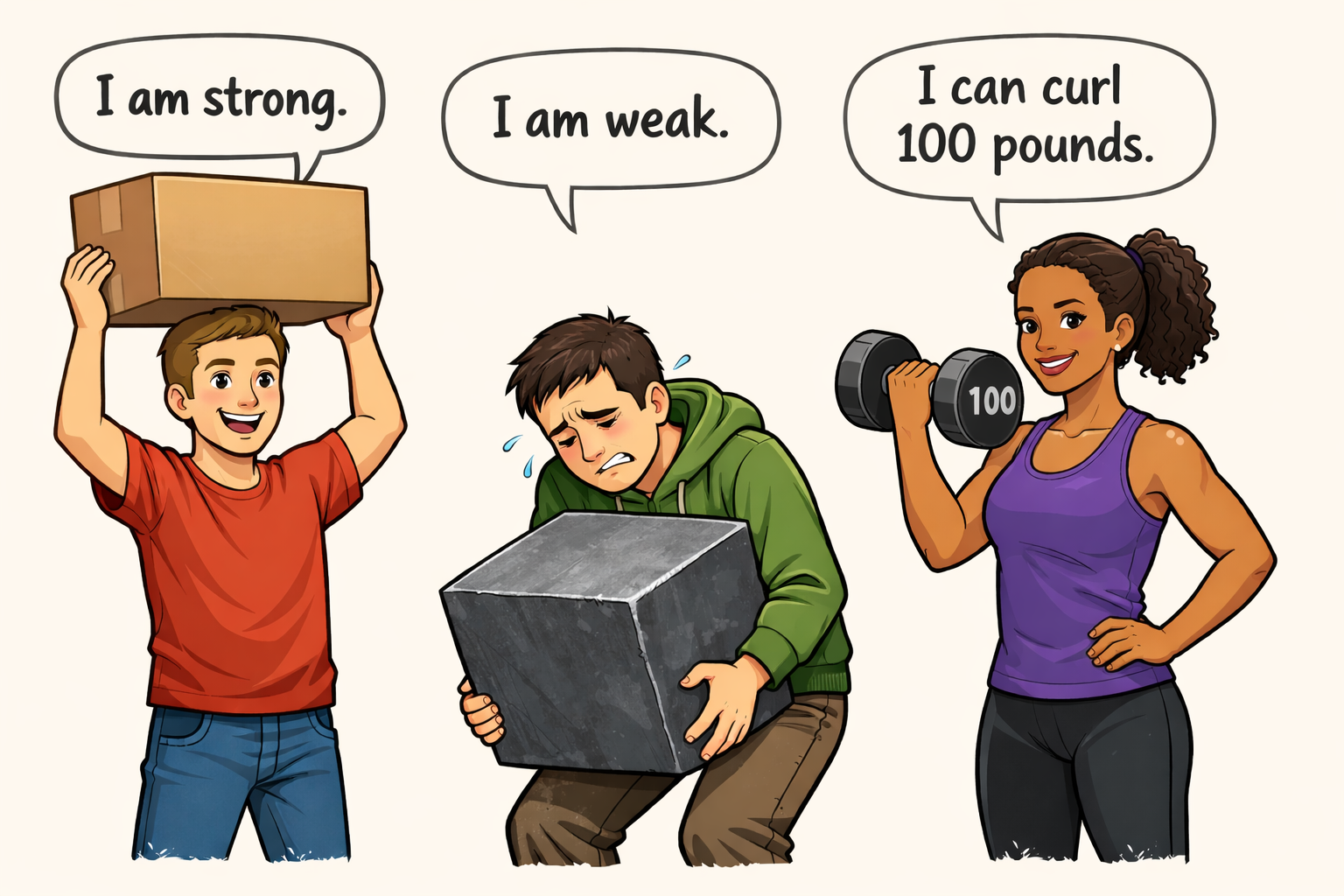
In recent years psychologists have scrutinized past studies and discovered that in assessing our own competence, we have a strong tendency to lean toward the median. Moreover, it seems that most of us who are beyond the starting gate are very incompetent in estimating where we stand in a knowledge competency category.
Here is an example. I think the writing of this blog is not too bad, but not great either. It is probably in the middle in quality of blog posts out there. Yet when I read over it later, I will come up with a different assessment.
But wait! There is more! We think we know things or can do things when we have a strong reliance on cultural knowledge. What's that TV game show where one can call a friend for help in answering a question?
Endearing to See in Others
Here's something I've noticed: humble people are easy to be around.
When someone isn't ego defending, the room gets bigger. There's space to think, space to be wrong, space to explore an idea without it becoming a battle. You can say "I'm not sure about that" without worrying you've insulted them.
The humble person can hear "I think you're mistaken" and respond with genuine curiosity: "Show me." Hmmm. Am I talking about you or me or the one who just walked into the room.
Humility is an enabler for working together, alongside. A place for collaboration.

This is why humility enables that collaboration: If I'm welded to being right, I can't actually think with you. I can only defend or attack. But if my identity isn't riding on every opinion I hold, we can actually look at the evidence together. We can change our minds. We can get somewhere.
I find this quality endearing in others. It signals: I can work with this person. We can enjoy that work together. If I challenge the other on the wiring diagram, it is not taken as a character assault—we both want to see if the circuit actually works.
Endearing to Hold
Humility in itself is warm and fuzzy. That is OK! We can embrace humility. We can be brainy and think that humility is good. Yet, we can also find it warm and filling. Hugging. That humility can merge with each of us. It can be part of me.

I can cherish humility and let it merge with me.
What It Feels Like From Inside
Here's the part that surprised me: humility is relaxing.

That sounds wrong. We usually imagine humility as discipline—constantly pushing down the ego, effortful self-suppression. But that's not my experience.
When I manage to let go of being right, something unwinds. I stop monitoring. I stop rehearsing my next point while you're still talking. I stop scanning for threats to my self-image.

The scanning for self-image threats, all that vigilance, takes energy. Cognitive scientists call it "load"—the mental resources devoted to a task. (Throughout these posts, you will see references to cognitive load.) Defending your ego is expensive. Your brain treats threats to your self-image much like physical threats:
- Your heart rate rises.
- Your stress hormones flow.
- Your thinking narrows and is handicapped.
So, what happens in humility? This is enabled:
- Your body remains alert but calm.
- Your brain's demand for fight/flight/freeze are cushioned.
- Your thinking is enhanced and exploratory.
- You speak in a manner where associates hear.
I'll bring up more on the neuroscience when we discuss values grounding, my name for the habit that provides security and threat handling.
Humility, when it actually arrives, feels like putting down a weight you forgot you were carrying. Suddenly there's attention available for other things. For the person in front of you. For the problem you're actually trying to solve. For noticing that you might be wrong—and finding that possibility interesting rather than terrifying.

The Paradoxical
Security
Here's the strange thing: humility requires security.
To tolerate being wrong, to hear criticism without crumbling, to hold views with one hand and reach out with the other—you need to know that your worth doesn't depend on being right.
This is why insecure people often seem arrogant. They can't afford to be wrong. Their identity is riding on every interaction. So they double down, deflect, attack. It looks like excessive self-confidence, but it's the opposite: a self so fragile it must be defended constantly.
The humble persons have a different foundation. Their worth is settled. Not because they've achieved something, but because they're grounded in something that doesn't shift with each argument won or lost. Coming soon is a post on grounding values.
Self
There are also twists that seem to be paradoxes involving self.
One applies here. If we turn away from looking at self and look to fun, dreams, and others, are those not selected by self. Are those things that bring joy to self? Even if one submits to God and adopt God's goals, that submission and adoption are choices. If one joins an orchestra and follows musical leadership, it is a choice. One doesn't focus on how this benefits the self when making music. That is, the choices and even continual enjoyment are light events and processes allowing one to move forward in chosen or adopted goals for important things.
Humility in Conversation
Humility is a significant foundation for fruitful dialogue. Often, it is essential.

Without it, conversations become performances. Each person broadcasts; no one receives. Disagreement triggers defensiveness. Evidence that challenges my view becomes evidence of your hostility.
With humility, something different becomes possible:
- I can hold my views firmly without clutching them
- I can be curious about your perspective, even when I think you're mistaken
- I can say "I hadn't thought of that" without feeling diminished
- I can change my mind and feel richer for it, not defeated
This doesn't mean being a pushover. The humble person can engage passionately and does not confuse the dialogue with a war.
Becoming Humble
I'm no expert, but...
What I can say is that humility seems to grow in certain conditions:
- When I remember that I've been wrong before—confidently, completely wrong—and the world didn't end
- When I spend time with people who model humility
- When I'm secure enough in what matters to me that I don't need every interaction to validate me (more soon)
- When I get curious about why someone sees things differently, rather than just marshaling my counterarguments
The last one has a special place. Curiosity and defensiveness can't occupy the same space. If I'm genuinely wondering what you see that I don't, I'm not defending anything. I'm exploring.
An Invitation
Humility isn't a destination. It's more like a direction—a core I keep wandering away from and returning to. I keep changing in who I am and in my ability to assess that. Humility requires continual washing and refreshing.
But when I'm there, even briefly, I notice the difference. My shoulders drop. My mind opens. The person in front of me becomes more interesting than the performance I was about to give.
If fruitful dialogue is what we're after, this is where it starts: not with better arguments, but with a quieter ego. Not with thinking less of yourself, but with thinking of yourself less. You can take a test, note the score, remember the score and then not dwell on it.
Over time, you and I might find that this is the norm, always refreshed, always there.
And finding, to your surprise, that there's more room for everything else.