
Mika Negative Numbers
Write Mika negative numbers with a hyphen in front.


Negative numbers are like simple numbers but go in the opposite direction from zero. Combine them with sufficient natural numbers and we get enough Mika integers.
Review
Digits
Digits are graphemes with names. Just ten pictures. However, each has associated with it a numerical value.

se 0
bi ta bo 1 2 3
tu be ki 4 5 6
ba ko gu 7 8 9
Counting Numbers
The numbers 1, 2, ... n can be represented by a sequence of digits of sufficient length.

Whole numbers
The numbers 0, 1, 2, ... n can be represented by a sequence of digits of sufficient length. This is done by simply including zero, se in Mika. When we add in the negatives of the counting numbers below, we will get the Mika integers.
Decimal-point Numerals and Simple Numbers
Adding a decimal point, an easy to type grapheme, allows numerical values before (less than) one (1) to be represented by a sufficiently long digit sequence. A digit before the point is required; no numeral starts with decimal point.

The decimal point is written out or spoken by the simple word an.
When we consider negatives below, a numeral with digits to the left and to the right of the an, a decimal-point numeral — or a numeral with no an — represents a Mika integer. Examples are 42, 0.02 and 3.14. And as we will see below, -25.
Digit Grouping
If there are several digits in a numeral then digits are grouped by threes to both sides of the decimal point.

The group separator is a typed (or drawn) space or, in formatted numerals, a thin space.
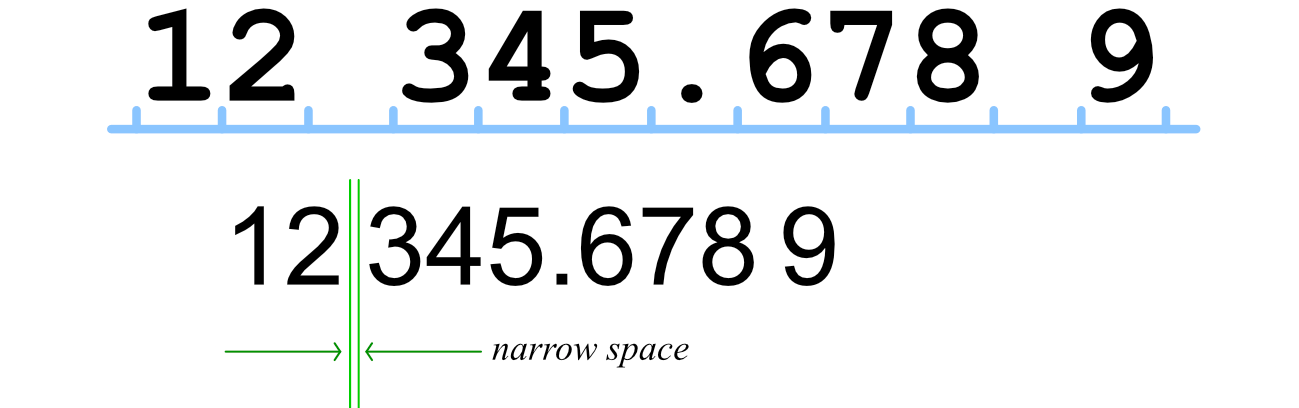
There is an exception to this symmetry in grouping, the four digit numeral.

Compacted




Integers, allowing Negatives
The zero, se, is the base (bottom) of the whole numbers and decimal numbers. All others come after zero and are called positive.
To handle situations were one is taking away a pile of dirt and takes too much, leaving a hole, we want something on the other side of the number se. These are negative numbers. We can write these as negative numerals. The se is a mirror.

The numerals of the negative reflection of positives start with -, nen. The nen symbol is the hyphen on the keyboard and in ASCII coding. To write a negative (form a negative numeral), simply put nen (-) before the associated positive.
-56 001.002
nen be ki se se bi an se se ta
For programmers: This is not the negation operator we see in programming languages C and Python. It is part of the number as in Java and Fortran programs. The number nen ba is like ¯7 in the programming language APL. Numerical negation and subtraction are separate from numeral formation in Mika.
The number se is not the bottom, front or base of Mika integers. It is important, though. We can think of it as the anchor of a number line, perhaps a middle.

Infinity
In Mika one can make numerals as colossal as one cares to write. Those represent the core Mika numbers.
But what about π and the infinite set of integers? These notions are not part of Mika core numbers. They require a different, perhaps firmer, mathematical foundation. These concepts are described in mathematical terms, readily discussed in Mika. Both infinite leaning and finite leaning mathematics are welcome.
If you want to discuss 3.1415... and ...-3, -2, -1, 0, 1, 2, 3... in Mika, there are ways, perhaps built on the simple Mika concepts of numbers or built another way as pleases the mathematician.
At this point, no infinity. No traditional infinite number sets.

Quiz
nen bi ta bo se se se an tu be ki ba ko gu
How can that be written using digits, an, nen and spaces?

Should there be a counting song?
se
bi ta bo
tu be ki
ba ko gu