One Thing does Not Belong
Among the good things coming out of Sesame Street, are some harmful themes including one that is a detriment to fruitful dialogue.


I make the outrageous claim that a theme of Sesame Street has contributed to the tensions among humans today. We might be able to debate concerning the related harm of other themes, but here I focus on the heavy emphasis of the excluded in examining and reasoning about kinds and instances.
My primary pain point is this:
One of these things [just] does not belong.
Background
In the 70's, Sesame Street was the best known and highly acclaimed television show for childhood learning. The accessibility tended to reach across regions and various cross sections of people. It focused on a core set of concepts. It is even praised in-house today (Truglio & Nash) as well as outside the Sesame Street community. It was guided by education experts and the way many people think about education has been influenced by Sesame Street. Its influence continues. The idea of children being prepared for school is important to people.
The child development foundation of Sesame Street is based on the work of behavior scientist Ed Palmer, an expert in designing TV shows that minimize the chance that the viewer will change the channel.
For Sesame Street, Palmer developed the "distractor" methodologies that indicate how well do candidate segments hold the attention of children with possible distractions. Developmental psychologists Daniel R. Anderson and Heather L. Kirkorian noted that the fast pace and high stimulation of Sesame Street—designed to hold attention—might condition children to expect rapid changes, potentially leading to shortened attention spans and reduced capacity for reflective thinking. Teachers have a high bar in keeping things exciting all day. However, this engagement encourages some of the social aspects of entering students that teachers want, staying on task, following a sequence of tasks, respecting authority. Interestingly, teachers often blame controlling parents that do allow any freedom for their children. Teachers also want to see other social aspects such as the ability to make friends and the ability to recognize that classroom resources are to be shared.

The behaviorist approach (after Skinner) encourages making a choice from a small set of responses to stimuli. This allows a child to make a self assessment that can be encouraging to a child entering school. However, this pushes assessment in education to be centered around multiple choice questions or requiring an answer from a well-defined approved set of multiple answers. Like the above distractor problem, this discourages exploration and thinking outside the box. The Sesame Street approach focuses on surface-level engagement rather than cognitive comprehension or long-term retention.

Sesame Street encourages inclusiveness though examples of those who belong. A learner can generalize from this. However, the above two themes discourage this. (And one can also argue that the examples on Sesame Street are biased.)
The educational topics of Sesame Street are few. This is reasonable; it cannot do a good job when it is all over the place. However, in the environment of the above, it encourages thinking that real learning, real education is limited.
These also lead to shallow reading skills. (To break out of poor reading skills look at the classic How to Read a Book or the more modern Make it Stick by Brown, Roediger and McDaniel.)

The social interaction model of Sesame Street might be contrasted with that of Mr. Roger's Neighborhood.
One of these Things is Not like the Others
As you know, I promote fruitful dialog. From that view, I see this core theme of Sesame Street, One of these Things is Not, to be the most damaging to individuals and their emergent society. Jack Migdalek (University of Melbourne) calls this the Sesame Street mindset.
The schema was designed by a Sesame Street founder Joan Cooney to teach classification, comparison and sorting. This might be the only non-numerical mathematics in the show. Can you think of other non-numerical mathematics in Sesame Street?
This is by far the number one most used cookie cutter in Sesame Street. Four images are presented. A popular character or a chorus sings, "One of these things is not like the others, one of these things does not belong." Does not belong. Does not belong. The singing continues allowing the observing child to come up with a guess.
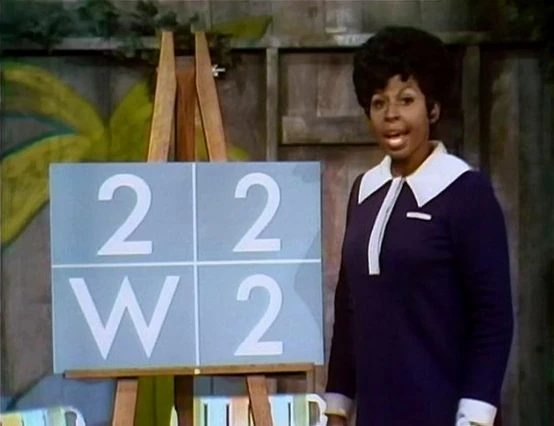
"One of these is Not" first appeared in the very first episode and in the 1968 proposal. It was used over seasons many more times than "Three of these Things". And that was used more often than other classification songs. Perhaps "Three of these Things" did not fit into the behaviorist's model.
Fitting the Multiple Choice Question
The neatness of "One of these is Not" allows a simple 4-choice multiple choice question on tests, constraining any answer. The test taker might ask "What answer What does the teacher want?" If presented are three teacups and a donut, the donut must be the answer. But wait. One of the tea cups has no handle. Maybe the lack of the hole makes a difference. The child must make an effort. What is the RIGHT answer? The RIGHT answer is that which puts the child in line with authority. The right answer provides the highest grade.
An encouraging teacher might ask a class, "In what way are these four alike?" This can lead to active discussion—sometimes goofy. Children can come up with their own answers using their words and might even notice ways the teacher did not expect. Yet eventually the question on the test is multiple choice. The appearance of choice is a lie.
The Promotion of Exclusion
This theme promotes the exclusion of ideas, things and even persons. This makes it hard to learn how to talk with others who disagree. Persons will tend to be tribal and will likely be confused about words. Rather than looking at how two concepts share attributes, we see one as belonging to the good and the same as our good ideas, and the other concept as not belonging.
This also applies to proponents of ideas. That person does not belong.

Finding Common Ground in Taxonomy
In taxonomy we consider kind, instances of kinds and even sub-kinds. As we learn more, we are introduced to joins, finding the kind that that includes both.
To find the core common aspect of two ideas, we have to strip away attributes and axioms until we have the same thing. That same thing might even be an idea that two people like. This naked shared notion can have features added on to form the different ideas. The two persons in discussion now have a better idea of the two notions, regardless of whether each thinks the other is labeling the two notions wrong or not.

And this becomes important for persons. What do they have in common? Start with the goofy such as "They both have left hands." Move to "They both like dancing." That can lead to something important, "They both want to promote joy."
Successful fruitful dialog might mean our learning to understand what many humans have been been going through in the learning process. There are things we might need to unlearn to be successful, those things I claim are in the Sesame Street regime. We can recognize this in ourselves.
In Fruitful Dialog?
Let's consider how things, ideas and persons are alike.