
Mika Sounds
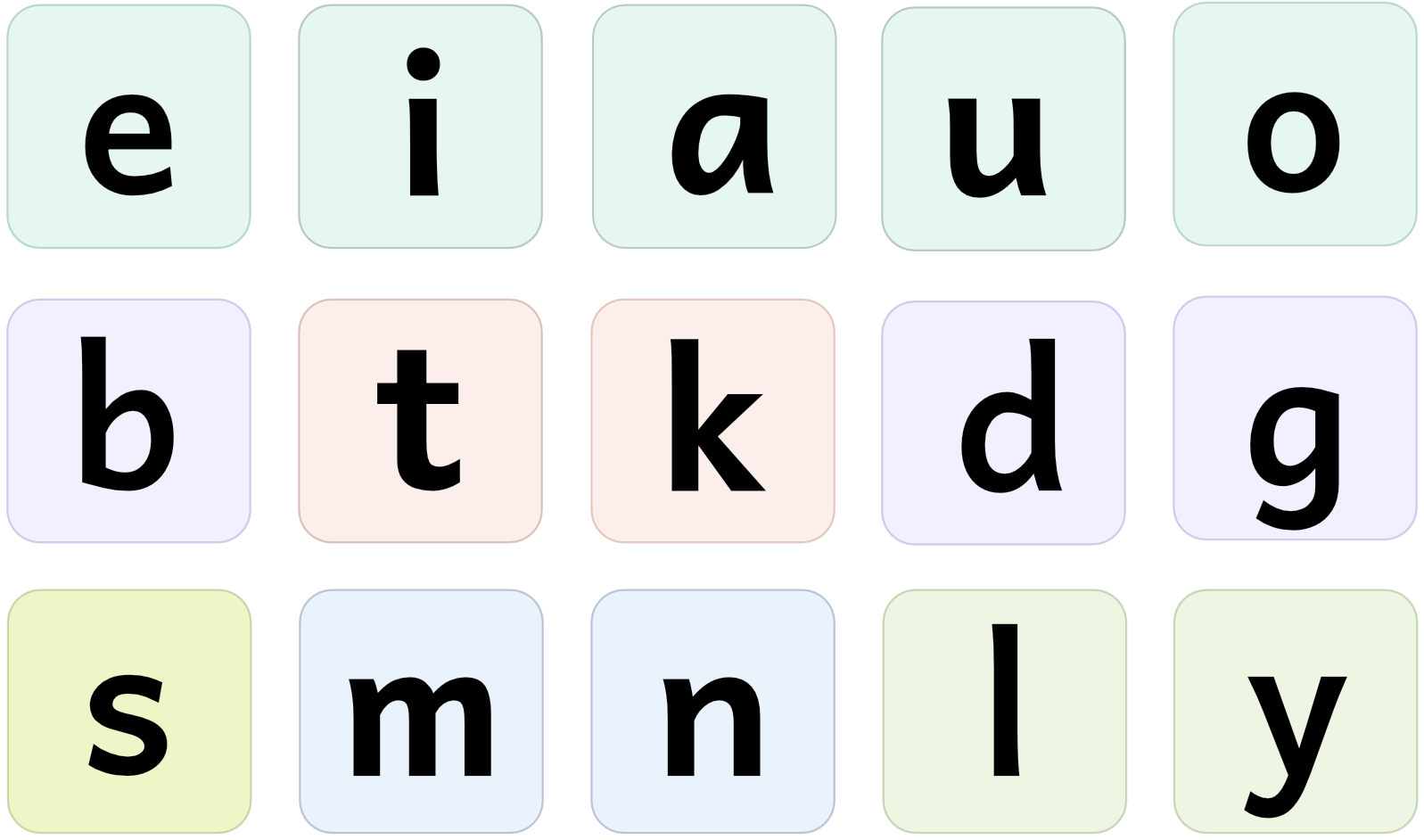
Mika has 15 sounds, most speakers of the world can say them immediately.


Earlier posts described letters and provided motivations for the sound selection. Here the sounds are described.
As described in a post soon, the letters (graphemes) and the sounds (phonemes) are bound. The letter and the sound are represented the same way. Those are distinct in general, but in learning Mika, they are the same. This post does not say much about IPA notation and the big words of phonetics.
The inventory of sounds is small. Selection took into account both articulation and hearing by speakers around the world. Social aspects were also considered. Some regularity and rich production was sacrificed in this to meet those goals. Even so, there are patterns in the sounds. Distance was also a concern, both in how letters look and how the sounds are spoken.
Vowels
There are five vowels in Mika.
| MIKA | SPANISH | ITALIAN | INDONESIAN |
|---|---|---|---|
| a | casa | casa | apa |
| e | peso | verde | enak |
| i | si | vino | ini |
| o | no | sole | orang |
| u | tu | luna | susu |
These are pure vowel sounds. The vowel in English "bay" would not be a good example of the sound of e in Mika—unless you chop off the end of the vowel sound. English speakers often end a vowel with a slide into another vowel. This means a little more work for English speakers in learning Mika, but it is easy to be patient with Mika students coming from English.
Consonants
There are ten consonants in Mika. These can be divided into groups of five. One way is by stops and others. Here, the two groups are based on convenience in comparing to Swahili and Japanese.
Swahili Comparisons
| MIKA | INDONESIAN | SWAHILI | ENGLISH |
|---|---|---|---|
| b | buku | baba | book |
| d | dua | dada | door |
| g | gula | gari | go |
| m | mata | mama | man |
| n | nama | na | no |
The b and d sounds of Swahili are interesting and don't quite hit the mark, but we embrace those as possible ways to hear b and d in Mika.
Japanese Comparisons
| MIKA | INDONESIAN | JAPANESE | ENGLISH |
|---|---|---|---|
| t | tiga | taberu | stop |
| k | kaki | kaki | sky |
| s | satu | sakana | see |
| l | lima | — | leaf |
| y | ya | yama | yes |
The examples "stop" and "sky" emphasize that a puff is not in the perfect pronunciations — but we accept the puff in hearing.
The l sound in Japanese is around d, l and r for many listeners. However, there is no r or similar sound in Mika; a competent Mika listener will understand l by a Japanese speaker OK. There is a little extra effort in fully acquiring the Mika l sound for the Japanese learner.
Learning the sounds
Speakers of Spanish, French, Portuguese, Italian, Russian ,Indonesian, Nigerian Pidgin and Bengali already can make these sounds.
The sounds of t, k, b, d, g might be new to Mandarin speakers, but they can be learned as a group. The voiced consonants b, d, and g might take more time to learn.
Swahili speakers will have to work a little on b and d.
English and Arabic speakers might need to work on e and o. Arabic speakers from some regions might need to learn g. English speakers might also struggle with vowel u.
The new sound for Japanese speakers is l. The other sounds are essentially native.(I'm counting u as native, though some might not agree.)
Speakers from any of the top languages can easily learn Mika sounds. Give speakers of English, Mandarin, Arabic (MSA) and Japanese a little extra time. The sounds of the Mika word 'mika' meaning Mika are native in the top languages, but the k might take concentration for Mandarin speakers.
The Mika sounds that are native across the top languages are a, i, m, n, s, and y. If 'manisiya' becomes a word in Mika, then you can say it now. No Mika sound is non-native in more than two of the top 14 languages.