Mika Letters and Sounds
The way letters are drawn and the way they are spoken are bound in a one-to-one marriage in the Mika language.


The developing crafted language Mika has letters and sounds.
Some Big Words
Letters are among the graphemes of a language as are digits. A glyph is one way a grapheme may be drawn. (This is not exactly the same as the usage in the Unicode standards.) A grapheme is the abstraction, a glyph is one specific way to write down the grapheme. This relationship between a grapheme and one or more glyphs is expressed by saying the grapheme has allographs (those glyphs). A grapheme might be written with angle brackets.
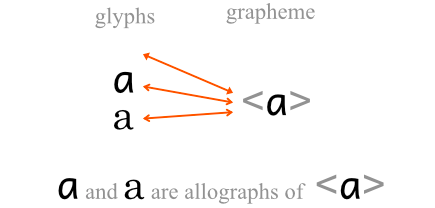
Similarly, the sounds of a language are the phonemes, which, in general, can be represented by several phones depending on the context. The phones are specific articulations. Those several phones are called allophones of that phoneme.

The grapheme is said to spell the phoneme.
The relationship between graphemes and phonemes has a name: grapheme–phoneme correspondence (GPC), the bread-and-butter term in reading, literacy, and orthography studies. It is related to phonics instruction.
An orthography is the whole writing system for a language. The GPC is the heart of an orthography — the mapping between symbol and sound — but not the whole of it. The digits and space are part of orthography.
A writing system where one grapheme (letter) maps to one phoneme and vice versa is called a transparent or shallow orthography (Finnish, to a large degree; Spanish closely). The opposite of transparent is opaque or deep (English, with its many-to-many mess).

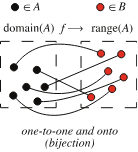
The transparent orthography is essentially what mathematicians call a bijection, one-to-one and onto. Its full orthography is everything built around that bijection. Consider the letters and the sounds, each as a set, an unordered collection without repeats. A bijection pairs the two sets perfectly: everything in the first set maps to exactly one thing in the second set, and nothing in the second is left out or doubled up. A two way projection. Because the pairing is exact both ways, you can run it in reverse.
Marriage
Mika has a transparent orthography. Graphemes (specifically, letters) and phonemes (sounds) of Mika are connected in a special way. They are married and that marriage is a thing.
What does it mean for the marriage to be a thing? Well, one can say, "Mika g extends below the baseline and is voiced". In Mika the word gun would be used to refer to the marriage g.
There is no bigamy in Mika. No digraphs, no split spellings, no shared sounds.The grapheme can be drawn many ways; the phoneme has one proper articulation, though tolerant listeners accept nearby phones. Yet in all of this, the letter and the sound are faithful.
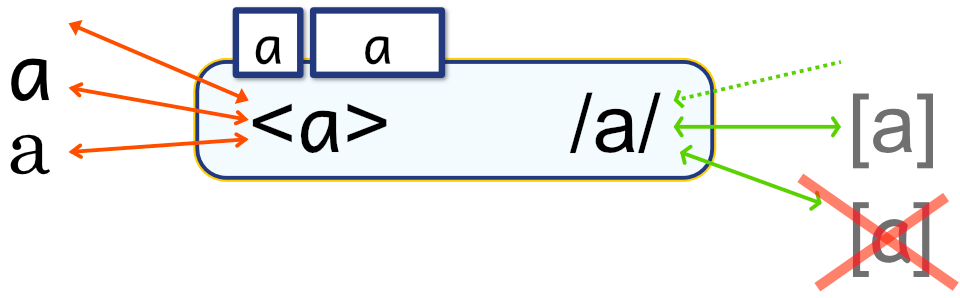
This can be illustrated graphically like this:
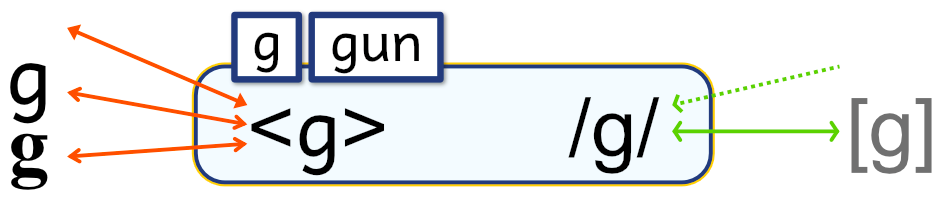
The grapheme is designated with the < > brackets. The phoneme is shown with the / / brackets. The single allophone is shown with the [ ] brackets. Here we see that both forms of g, hook and eye glasses, mean the same letter. The phoneme and phone use IPA notation and so have a hook, though I think most people would understand both forms. The dotted green line refers to the tolerance of listeners; some sounds are close enough.
The Marriages
Here are the couples in Mika:
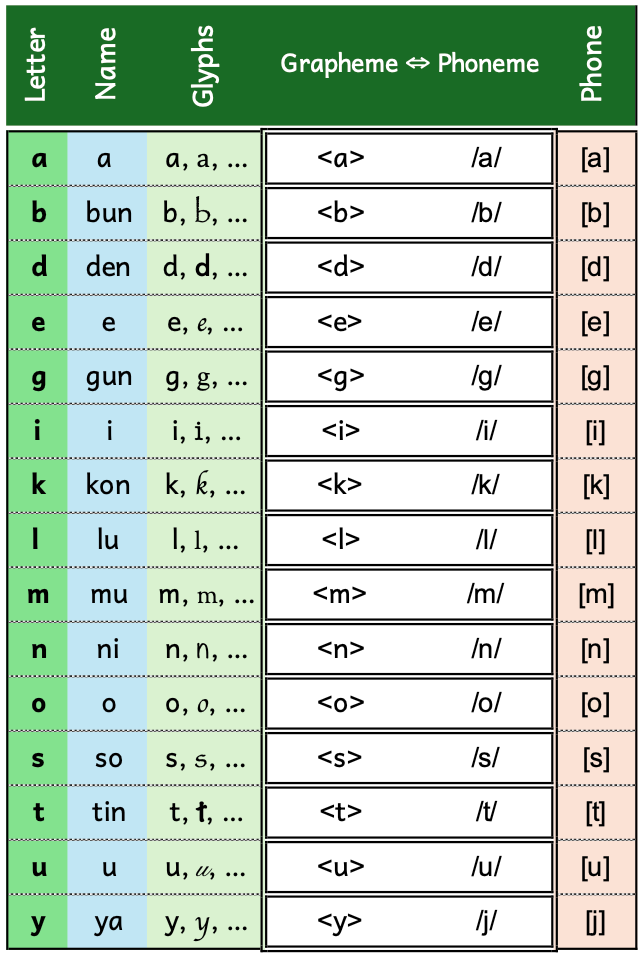
In most cases the symbol for the phoneme and the phone looks the same as the grapheme. There are three exceptions.
As mentioned above, the phoneme of g and its phone should use a hook.
The voiced letters — b d g — and the voiceless ones — t k s — are told apart mainly by the voice: in b d g the throat is switched on, in t k s it is off. But there is a second, quieter difference you can feel with your tongue, and it is what lets Mika survive a whisper. The voiceless t and k are made with a sharp, tight touch: t with the very tip of the tongue, k with a firm press at the back. The voiced d and g are made flatter and more relaxed — d with the tongue lying broad behind the teeth, g with a softer, gentler contact at the back. So even with the voice turned off, a careful speaker keeps the contrast: sharp-and-tight for t k, flat-and-easy for d g. This is a help, not a law. Speakers from different first languages will lean on it differently, and that is fine — Mika's hearers are tolerant, and whispered Mika leans on context and Mika's built-in redundancy to carry what the whisper cannot.
Note that <y> is married to /j/. That j is sometimes called yod to avoid confusion with the sound in English "jam". Think about English "yes" and German "ja".
IPA notation uses variants of a to represent distinct sounds. There is only one way to "properly" say a.
Tolerance
Mika has a notion of hearing tolerance. It is built into the Mika culture.
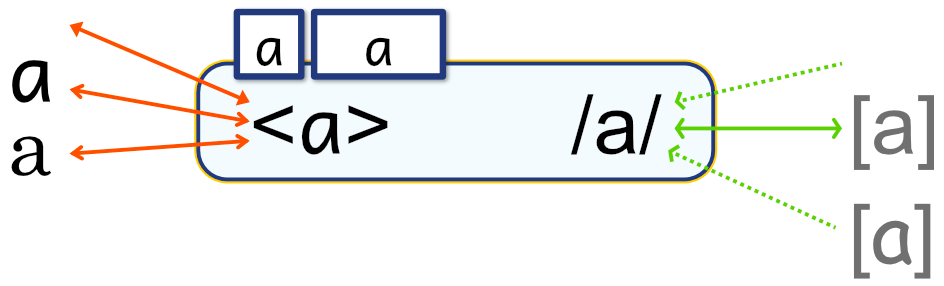
The hearer often accepts nearby phones for a phoneme as though they are allophones. That is, a Mika speaker might be able to listen to speech by a noob and understand. Some speakers might speak with a weird accent (as you or I might) and many who know Mika will understand. And we might whisper or talk with mouths half full.

This is a gift from hearers to speakers. This should not be taken for granted. This tolerance takes brain power, and it thus weakens comprehension and consideration. If you want to talk with people of a different world view with Mika, then strive for a good Mika pronunciation. The person with a different world view might be confused with how you use words; there is no need to burden the conversation with more weight. This tolerance requires cognition — attention spent decoding a heavy accent is attention not spent on meaning.

Sometimes hearing is aided by the built-in redundancy in Mika. Also, the stumbling in hearing can be repaired. Also, a stumble in hearing can be repaired — sometimes right away, sometimes set aside and returned to. Mika has dialog interjections for this.
So, for some listeners...
Alphabet Song
If there is an alphabet song, maybe it will be organized into groups each starting with a vowel like this:
Letters:
a b d e g i k l m n o s t u y
Names:
a bun den e gun
i kon lu mu ni
o so tin u ya
Maybe a kid's song would go like this:
a bun den
a bun den
a bun den e gun
i kon lu
i kon lu
i kon lu mu ni
o so tin
o so tin
o so tin u ya
Whatcha think?
Later we can get to the word for alphabet. abudee?